📖 What's in This Guide
⚠ COPPER vs. STEEL — THE TWO WORLDS OF 1943 PENNIES
Most 1943 pennies are zinc-coated steel — common, silver-colored, magnetic, and worth 10¢–$20. A tiny number (~40 known) were accidentally struck on leftover copper planchets from 1942. Copper examples are non-magnetic, weigh 3.11g vs. 2.70g, and have sold for up to $1.7 million. The magnet test takes 3 seconds. Do it first.
How to Identify a 1943 Steel Penny:
- ✓ Silver-gray appearance — unique in the Lincoln cent series; all other Wheat pennies are copper-brown
- ✓ Magnetic — holds to a refrigerator magnet. The only circulating U.S. cent ever made of steel
- ✓ Weight: 2.70 grams — lighter than copper Lincoln cents (3.11g)
- ✓ Diameter: 19.05mm · Plain (smooth) edge
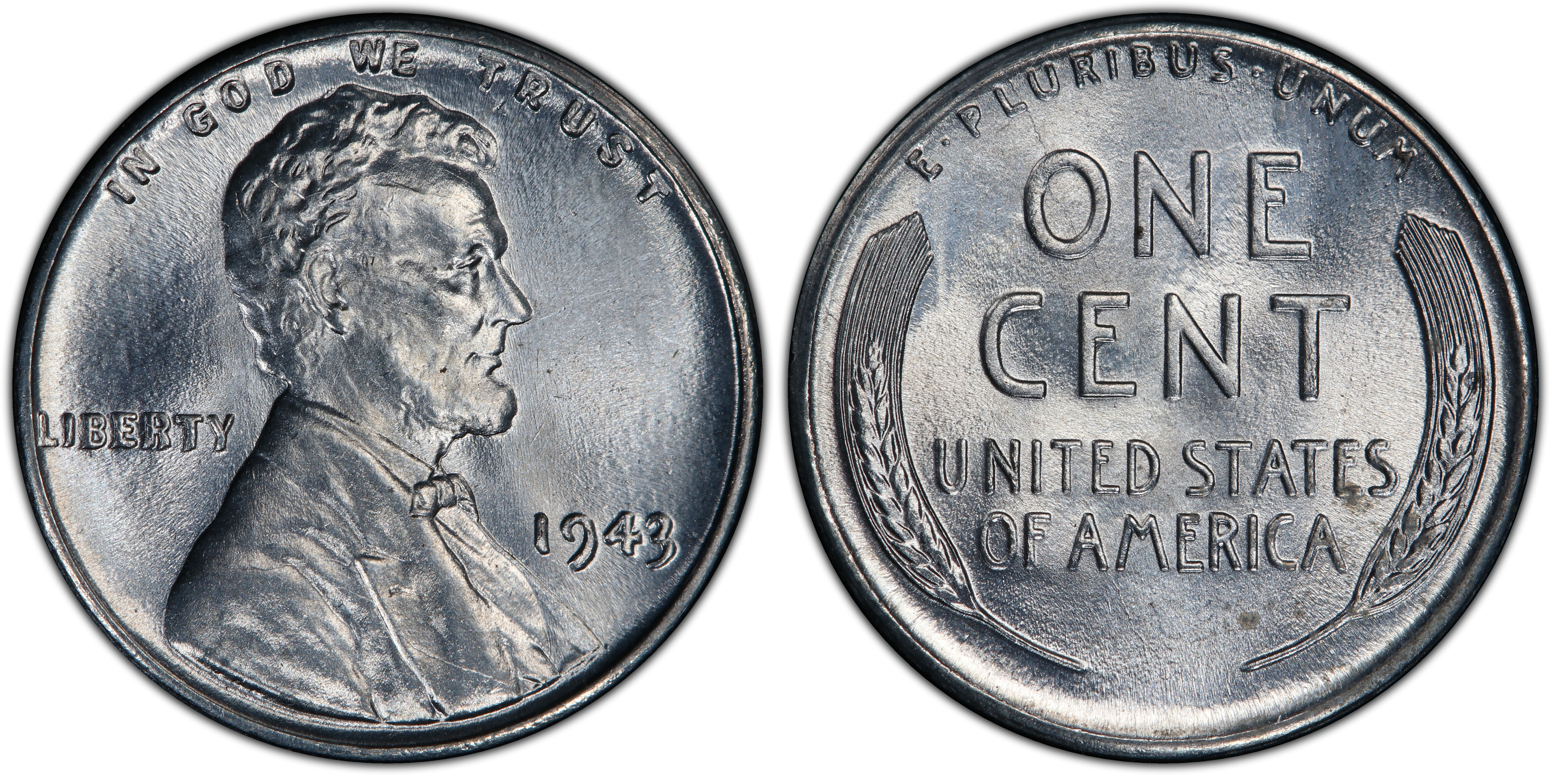
- ✓ Mint mark below date on obverse (front): none = Philadelphia · D = Denver · S = San Francisco
- ✓ Wheat reverse (Wheat Penny): ONE CENT flanked by two wheat stalks, E PLURIBUS UNUM above
- ✓ Composition: low-carbon steel core + thin zinc coating (zinc wears away, exposing steel to rust)
- ✓ Minted one year only — 1943 is the sole year of U.S. steel cents in circulation
Designer: Victor David Brenner (1909). The same Lincoln portrait and Wheat reverse design used 1909–1958. The 1943 steel cent is the most dramatic metallurgical departure in Lincoln cent history.
In 1943, with copper desperately needed for shell casings and communications wire, the U.S. Mint did something unprecedented: it struck America's one-cent coins from zinc-coated steel. The result was a penny that looked like a dime, stuck to magnets, rusted when the zinc wore off, and jammed vending machines. Over a billion were produced across Philadelphia, Denver, and San Francisco — making them among the most common coins a collector can find. Most are worth exactly what they look like: very little.
The NGC Coin Explorer for the 1943 Lincoln Cent (MS) tracks certified population data, auction records, and price history across all three mint facilities — from common circulated steel examples to the top-pop MS68+ coins that have sold for $19,200. Understanding where your coin lands on that spectrum begins with two simple tests: a magnet and a scale.
“The 1943 steel penny is the perfect beginner's coin — affordable, historically significant, and hiding one of the greatest secrets in American numismatics. Every one that comes out of a coin jar deserves a magnet test. Somewhere out there, a copper one is still unidentified.”
The 60-Second 1943 Penny Test
Before anything else — magnet and scale
The Traffic Light System
Red = Worth face value (1 cent–$1)
Magnetic + 2.70g + silver-gray = common steel cent. Circulated: 10¢–50¢. Nice uncirculated: $1–$15.
Yellow = Worth investigating ($15–$500)
Magnetic + high grade MS66+, D/D RPM, off-center strike, or double strike — examine under magnification
Green = Potential jackpot ($100–$1,700,000)
NOT magnetic + 3.11g + brown/reddish = possible copper penny. STOP. Do not clean. Seek professional authentication immediately.
Table 1: 1943 Penny — First Glance Value Indicators
| Test | Steel (Common) | Copper (Rare!) | Action |
|---|---|---|---|
| Magnet test | Sticks firmly ✅ | Does NOT stick ⭐ | If no stick: weigh immediately |
| Weight | 2.70g | 3.11g ⭐ | Use digital scale (0.01g) |
| Color | Silver-gray (or rusty/dark) | Brown / reddish-brown ⭐ | Natural toning, not coating |
| Mint mark location | Below date on obverse (front): none=P, D=Denver, S=San Francisco | Check D for RPM under loupe | |
| Condition / Grade | Zinc coating intact? Rust? Original luster? Step from VF to MS makes huge value difference | Grade carefully — surface matters | |
| Fake alert ⚠ | 1948 date filed to look like 1943; copper-plated steel cents; altered dates from other years | Always submit suspect copper cents to PCGS/NGC | |
👉 Reality Check:
The overwhelming majority of 1943 pennies are common steel cents worth 10¢–$1 in circulated grades. The value story has two distinct chapters: steel cents where condition and zinc coating integrity drive value, and the legendary copper cent where a single coin can retire its owner. The magnet test settles which chapter you're reading in three seconds.
1943 Steel Penny Varieties: Philadelphia, Denver & San Francisco
Three mints, three different rarity levels
All three U.S. Mint facilities struck steel cents in 1943, and the mint mark location changed from previous years: instead of the reverse (back), the D and S mint marks appear on the obverse (front) below the date — a placement used only in 1943. Philadelphia coins, as always, carry no mint mark. While Philadelphia struck by far the most coins, the relative scarcity of high-grade Denver and San Francisco examples — particularly with intact zinc coating and full luster — drives significant premiums at MS67 and above.
Table 2: 1943 Steel Penny — Varieties at a Glance
| Variety | Mint Mark | Mintage | Notes | Value Range |
|---|---|---|---|---|
| 1943-P (No Mark) | None | 684,628,670 | Most common; abundant in all grades | $0.10–$6,600 (MS68) |
| 1943-D | D below date | 217,660,000 | Check for D/D RPM FS-501; scarcer in top grades | $0.15–$14,400 (MS68+) |
| 1943-S | S below date | 191,550,000 | Lowest mintage; highest premiums at MS67+ | $0.20–$19,200 (MS68+) |
| 1943-P Copper ⭐ | None | ~15–20 known | NOT magnetic, 3.11g, brown — ultra-rare error | $100,000–$400,000+ |
| 1943-D Copper ⭐ | D | 1 confirmed | The only known specimen — world’s most valuable penny | ~$1,700,000 |
| 1943-S Copper ⭐ | S | ~5 confirmed | Second-rarest; MS63 sold for $504,000 | $200,000–$920,000 |
| 1943-D D/D RPM FS-501 ⭐ | D/D | 3,000–5,000 est. | Secondary D below-left; bold ghost impression | $70–$19,800 (MS66) |
⚠ Beware of Fakes — The Most Common Counterfeits
Copper-plated steel cents: someone electroplates a regular steel cent with copper. Apply the magnet — plated steel still sticks. Altered dates: scammers file the “8” from a 1948 copper cent to create a fake “1943” — check that the “3” has the correct long-tail serif. Both tests required: a genuine copper 1943 cent must be non-magnetic AND weigh 3.11g AND show correct date typography. Any doubt = professional authentication at PCGS, NGC, or ANACS before celebrating.
1943 Steel Penny Value by Grade
Current retail values — 2026 market data
Table 3: 1943 Steel Penny — Circulated to Mid-Grade Values
| Variety | Good–Fine (G–F) | VF–EF | AU58 | MS63–MS64 |
|---|---|---|---|---|
| 1943-P | $0.10–$0.25 | $0.25–$1 | $1–$3 | $3–$10 |
| 1943-D | $0.15–$0.50 | $0.50–$2 | $2–$5 | $5–$15 |
| 1943-S | $0.20–$0.50 | $0.50–$2 | $2–$5 | $5–$15 |
| 1943-D D/D RPM | $10–$30 | $50–$100+ | $100–$200 | $200–$500 |
Table 4: 1943 Steel Penny — High Grade MS65+ Values
| Variety | MS65 | MS66–MS67 | MS68 | Top Auction |
|---|---|---|---|---|
| 1943-P | $20–$50 | $100–$500 | $3,000–$6,600 | $6,600 MS68 (Heritage Jan 2025) |
| 1943-D | $25–$75 | $150–$700 | $4,000–$14,400 | $14,400 MS68+ (Heritage Jan 2025) |
| 1943-S | $30–$100 | $200–$1,000 | $5,000–$19,200 | $19,200 MS68+ CAC (Stack’s 2021) |
| 1943-D D/D RPM MS66 | $500+ | $2,000–$9,000 | $10,000–$19,800 | $19,800 MS66 FS-501 |
👉 Why Grading Is Critical for Steel Cents
Steel pennies grade differently than copper. The zinc coating on the planchet edge is always exposed bare steel from the blanking process — this edge rusts first. Coins with intact, even zinc coating and original luster command exponential premiums in MS67 and above. A single spot, rust stain, or cleaned surface can drop a coin from $1,000 to $50. For any MS65+ example, PCGS or NGC certification is the only reliable way to establish market value.
Is Your 1943 Penny Copper? The Complete Authentication Guide
The $1.7 million question — answered in four tests
The 1943 copper penny is not just the most valuable Lincoln cent — it is widely considered the most famous error coin in American history. When the Mint transitioned to steel in early 1943, a small number of bronze planchets from 1942 remained trapped in the press hoppers and were struck with 1943-dated dies before anyone noticed. Approximately 40 are believed to have survived across all three mints, scattered into circulation where most passed unrecognized for years.
Four Tests for a Potential 1943 Copper Penny
Magnet Test (3 seconds)
Hold a strong magnet (neodymium, not a fridge magnet) near the coin. Copper = zero attraction. Steel = sticks firmly. A copper-plated steel fake will also stick — do not stop here if it passes.
Weight Test (0.01g digital scale)
Genuine copper 1943 cent: 3.11 grams. Steel cent: 2.70 grams. Copper-plated steel: still 2.70g. A coin that fails the magnet AND reads 3.11g is extremely significant.
Color & Toning Inspection
Genuine copper cents develop natural chocolate-brown or reddish-brown toning over 80 years. The color should be uniform and consistent with aged copper. Bright orange suggests cleaning. A thin copper sheen over gray = plated fake.
Date Authenticity Check
Scammers file the “8” from a 1948 copper cent to create a fake “1943.” On a genuine 1943 cent, the “3” has a distinctive long-tail serif. Compare under magnification to authenticated reference images. Any scraping or tooling around the date = immediate disqualification.
If your coin passes all four tests:
Do NOT clean it. Store it in a soft coin flip. Submit to PCGS, NGC, or ANACS for authentication. The certification fee is trivial compared to what a genuine example is worth. Raw (uncertified) copper 1943 pennies draw extreme skepticism from dealers and auction houses.
1943 Steel Penny Error List with Pictures
Seven documented error types — from $20 die cracks to $1.7M copper planchet errors
The 1943 steel penny's unique zinc-coated steel composition created conditions that were exceptionally hard on dies. The hardness of steel planchets stressed working dies far beyond normal limits, causing rapid die fatigue, cracking, and repunching errors across all three mint facilities. Combined with the chaotic wartime transition from copper to steel production, these conditions generated a documented roster of error types that continue to attract strong collector demand. For the most current 1943 steel penny value on specific error varieties, professional authentication is recommended for any coin potentially worth $200 or more.
Table 5: 1943 Steel Penny — Error Coins Summary
| # | Error Type | Rarity | Value Range |
|---|---|---|---|
| 1 | Copper / Bronze Planchet Error ⭐ | Ultra-rare (~40 known) | $100,000–$1,700,000 |
| 2 | Off-Center Strike | Scarce | $20–$500+ |
| 3 | Die Crack / Retained Cud | Uncommon | $5–$100 |
| 4 | Repunched Mintmark (D/D RPM FS-501) | Scarce (3,000–5,000 est.) | $70–$19,800 |
| 5 | Double Strike | Rare | $100–$2,500+ |
| 6 | Strike-Through / Capped Die | Scarce | $25–$2,530+ |
| 7 | Missing Zinc Coating (Bare Steel) | Uncommon | $10–$75 |
Error #1 — Copper / Bronze Planchet Error
The holy grail of Lincoln cent collecting — ~40 known across all three mints
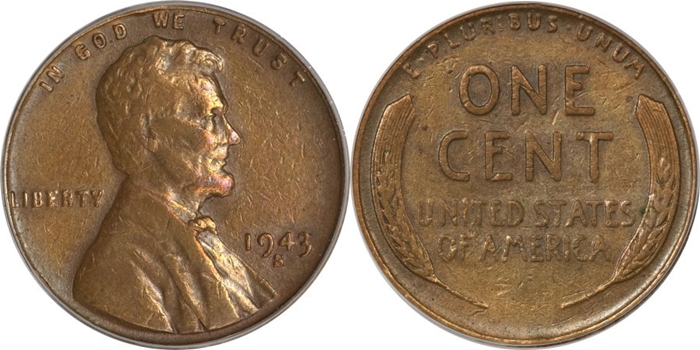
1943 copper / bronze planchet error — struck on a leftover 1942 bronze blank instead of zinc-coated steel. Non-magnetic, 3.11g, brown toning. The rarest Lincoln cent.
When the Mint transitioned to steel production in January 1943, a small number of 1942 bronze planchets remained trapped in press hoppers. These leftover blanks were accidentally struck with 1943-dated Lincoln dies before the error was detected, creating what many consider the most famous error coin in U.S. history. The 1943-D copper cent is unique — a single confirmed example sold privately for approximately $1.7 million in 2010. Philadelphia examples (15–20 known) range from $100,000 to $400,000; San Francisco (5 known) from $200,000 to $920,000.
Authentication Required:
Neodymium magnet test (no attraction) + digital scale (3.11g) + natural brown toning + correct “3” date serif. All four must pass. Never clean. Submit to PCGS, NGC, or ANACS only — raw copper 1943 pennies are met with extreme skepticism in the market.
Error #2 — Off-Center Strike
Design shifted during striking — crescent blank area; date visibility key to value
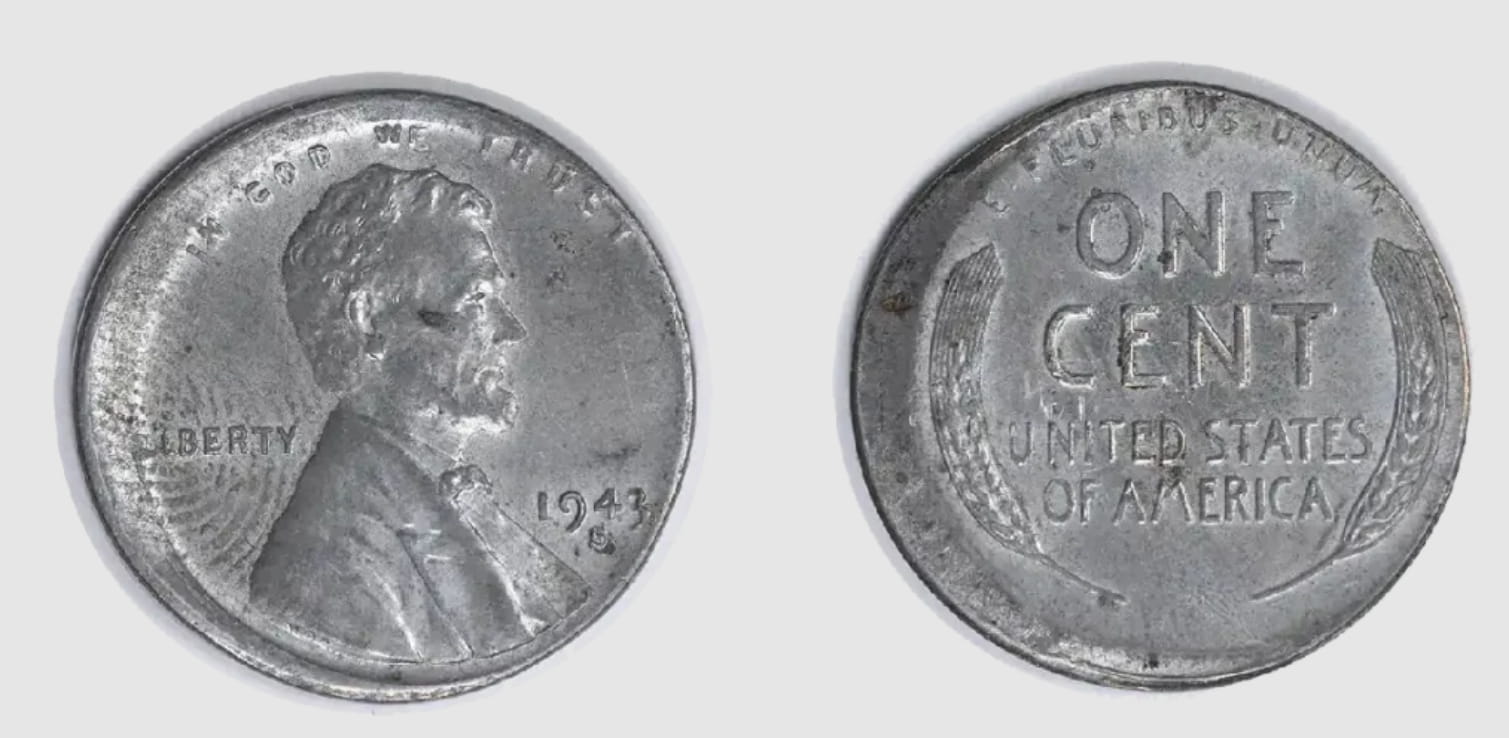
1943 steel penny off-center strike — planchet was misaligned during striking, producing a crescent-shaped blank area and shifted Lincoln design.
Off-center strikes occurred when steel planchets were not properly centered in the press during 1943's high-volume wartime production. The resulting coin shows part of the design shifted toward one side with a blank crescent area on the opposite edge. Value scales directly with the percentage of misalignment: 10% off-center = ~$50; 50%+ with visible date = $400–$500+. The date must remain legible for the coin to command full collector premiums. Dramatic examples with 40–60% misalignment showing a clear date are the most desirable.
How to Identify:
The blank area shows the original planchet surface — smooth and featureless with no design. On steel cents, the blank portion is silver-gray; the struck portion shows the normal design. Estimate the percentage of blank area (a 50% off-center coin shows roughly half blank). Date visibility is the top value driver — without a readable date, value drops significantly.
Error #3 — Die Crack & Retained Cud
Raised lines from die fatigue — especially common on 1943 due to hard steel planchets
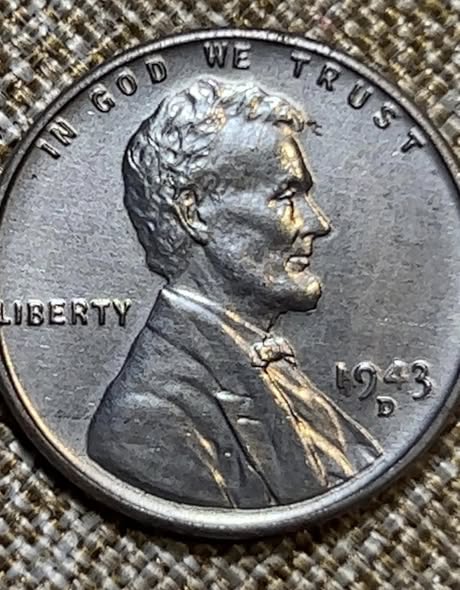
1943 steel penny die crack — raised line visible on the coin surface from a fracture in the steel die; cuds appear as raised blank blobs at the rim where the die has broken away.
The hardness of zinc-coated steel planchets placed extreme stress on dies during 1943 production, making die cracks more common on steel cents than virtually any other Lincoln issue. Cracks appear as raised lines on the coin surface, transferring the die fracture pattern into metal. The BIE error — a vertical raised line between B and E in LIBERTY — is a named variety found on 1943-P cents. Minor hairline cracks add $5–$15; major cracks through date or lettering bring $25–$50; retained cuds (where die material broke away entirely, leaving a raised blank blob at the rim) can reach $75–$100.
How to Identify:
Die cracks are always raised above the coin surface — run a fingernail lightly across the suspected crack. Raised = die crack (value). Incused/sunken = post-mint scratch (no value). Cuds appear as raised, smooth blobs at the rim where the die surface broke away. The famous BIE variety shows a small raised line between the B and E in LIBERTY on the obverse.
Error #4 — Repunched Mintmark (D/D RPM FS-501)
Only on 1943-D — ghost “D” below-left of primary; top auction $19,800 in MS66
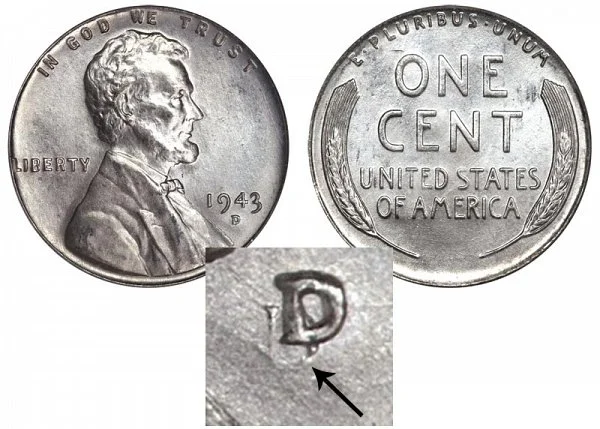
1943-D steel penny D/D Repunched Mintmark (RPM) FS-501 — a second “D” impression appears below and to the left of the primary mintmark under magnification.
The 1943-D D/D Repunched Mintmark FS-501 is the most significant variety in the 1943 steel cent series outside of the copper planchet error. In the era of hand-punched mint marks, the “D” on Denver dies was sometimes struck more than once in different positions. On FS-501, a bold secondary “D” impression appears below and to the left of the primary “D,” creating a distinctive ghost or shadow effect visible under 10× magnification. Estimated 3,000–5,000 examples exist across all grades; even circulated examples command $70–$200, while an MS66 example holds the record at $19,800. The distinction between FS-501 (bold, clear) and the lesser FS-502 (subtle) significantly affects value.
How to Identify:
Locate the “D” mintmark on the obverse below the date. Under 10× or stronger magnification, look for a secondary “D” outline below and to the left of the main letter. The FS-501 variety shows a bold, easily discernible second impression — often described as a “shadow D.” Compare to NGC or PCGS VarietyPlus reference images to confirm. PCGS/NGC certification is recommended for examples potentially worth $500 or more.
Error #5 — Double Strike
Coin struck twice by press — two overlapping full or partial impressions
1943 steel penny double strike — two complete or partial die impressions appear on the same coin, one rotated or offset from the other.
Double strike errors occur when a coin is struck a second time by the press, either at the same alignment (in-collar) or at a rotated or offset position (out-of-collar). The result is two overlapping impressions of the Lincoln/Wheat design. In-collar double strikes show a clean second impression directly over the first; out-of-collar examples show an offset or rotated second impression with a broadstruck appearance on the second strike. The dramatic visual impact of a well-centered double strike commands strong premiums from error coin specialists.
How to Identify:
Look for doubled design elements that show full-relief second impressions — not the flat, shelf-like appearance of mechanical doubling (machine doubling), which has no premium value. On a true double strike, both impressions show raised design with clear separation. Measure the rotation angle between the two impressions if discernible; dramatic rotations (90°–180°) command the highest premiums.
Error #6 — Strike-Through / Capped Die
Foreign material between die and planchet — including the dramatic Capped Die variety
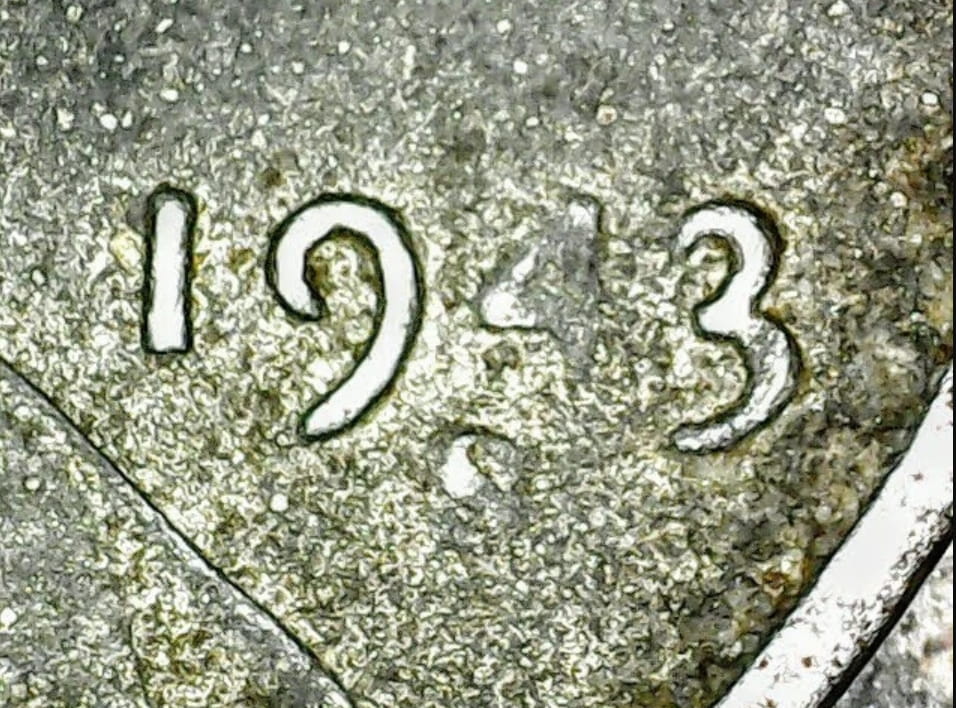
1943 steel penny strike-through — foreign material (grease, cloth, wire, or a die cap) between the die and planchet produces areas of missing or textured design, sometimes with the dramatic cap-over appearance of a capped die error.
Strike-through errors occur when foreign material is trapped between the die and planchet at the moment of striking. Standard struck-through grease errors ($25–$100) show smooth, flat areas of missing detail where die recesses were packed with grease. More dramatic struck-through cloth or wire errors create identifiable texture patterns worth $100–$500. The most valuable variant is the Capped Die error, where a previously struck coin sticks to the die and acts as a cap, striking subsequent planchets through this “cap” — a 1943-P Obverse Struck through Capped Die in MS63 sold for $2,530 in 2009.
How to Identify:
Struck-through grease appears as smooth, flat areas with missing detail that have sharp borders transitioning to normal design. Struck-through cloth shows a woven-fabric texture pattern. Capped die errors create a distinctive concave obverse and convex reverse appearance on affected coins. All genuine struck-throughs show the obstruction pattern as part of the original strike — not post-mint damage.
Error #7 — Missing Zinc Coating (Bare Steel Planchet)
Struck on uncoated or poorly coated steel — dull gray appearance, rapid rust susceptibility
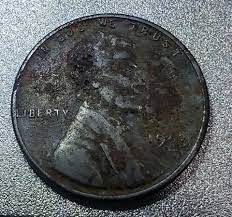
1943 steel penny missing zinc coating — planchet was struck without proper zinc coverage, leaving bare steel exposed that appears dull gray and is prone to immediate rust oxidation.
The zinc coating process in 1943 was imperfect — planchets were sometimes struck with uneven, thin, or completely absent zinc coverage. Coins missing their zinc coating show a distinctly dull, dark gray appearance instead of the normal bright silver-white luster of a well-coated example. The exposed steel oxidizes and rusts rapidly; examples that retained their bare-steel surface without further rust are more collectible than fully corroded specimens. This error is distinct from normal post-circulation zinc wear — genuine missing zinc planchet errors show consistent surface quality across the entire coin rather than patchy wear patterns.
How to Identify:
A missing zinc error shows uniformly dull, dark gray or black surfaces across the entire coin with sharp, well-struck design details still visible. The coin should be magnetic (confirming steel composition). Distinguish from post-mint corrosion — which shows pitting, scaling, and loss of design sharpness — by examining the strike quality. A genuine missing zinc planchet was still properly struck and retains full design detail beneath the dull surface.
Recent 1943 Steel Penny Auction Results
Heritage, Stack’s Bowers & NGC confirmed sales
Table 6: Notable 1943 Steel & Copper Penny Auction Records
| Coin | Grade | Sale Price | Sale / Year |
|---|---|---|---|
| 1943-D Bronze (Copper) ⭐ | MS64BN | ~$1,700,000 | Private sale, 2010 |
| 1943-S Bronze (Copper) ⭐ | MS63BN | $504,000 | Heritage, 2020 |
| 1943-P Bronze (Copper) ⭐ | MS62BN | $372,000 | Heritage, 2021 |
| 1943-P Bronze — Don Lutes Jr. | VF Details | $204,000 | Heritage, 2019 |
| 1943-S Steel ⭐ | MS68+ CAC | $19,200 | Stack’s Bowers, 2021 |
| 1943-D D/D RPM FS-501 | MS66 | $19,800 | Recent |
| 1943-D Steel | MS68+ | $14,400 | Heritage, Jan 2025 |
| 1943-P Steel | MS68 | $6,600 | Heritage, Jan 2025 |
| 1943 DDO | MS66 | $9,500 | eBay, 2004 |
| 1943 Strike Through Capped Die | MS63 | $2,530 | Auction, 2009 |
“In 1947, sixteen-year-old Don Lutes Jr. found a strange copper-colored penny in his school cafeteria change. He kept it for 70 years. In 2019, Heritage auctioned it for $204,000. The 1943 copper penny — the most famous error coin in America — is still being found.”
Best Coin Identifier App for 1943 Steel Pennies
Instant D/D RPM identification, error detection, and current market values
The 1943 steel penny presents specific identification challenges: distinguishing the D/D RPM FS-501 from the lesser FS-502 requires reference image comparison; grading zinc coating condition demands careful surface analysis; and identifying genuine die cracks vs. post-mint scratches needs expert guidance. CoinKnow's coin identifier app provides dedicated tools for all of these challenges — plus the critical magnet and weight test guides for potential copper penny identification.
CoinKnow — Coin Identifier
iOS & Android · Identify Any 1943 Steel Penny Variety in Seconds
RPM & Variety ID
Side-by-side FS-501 vs FS-502 comparison tools — high-resolution reference images showing exactly what to look for under magnification for the D/D Repunched Mintmark and DDO varieties.
Copper Penny Guide
Step-by-step authentication workflow for potential 1943 copper cents — magnet test guidance, weight comparison charts, toning analysis, and date typography verification with counterfeit examples.
Live Market Values
Real-time pricing from Heritage, Stack’s Bowers, and eBay sold listings — covering all 1943-P, D, and S varieties from common circulated grades to top-pop MS68+ and key error coins.
Download CoinKnow Free — Available on Both Platforms


📱 Pro Workflow: CoinKnow + Expert Grading
- Step 1: Magnet test immediately — steel sticks, copper does not. Non-magnetic = proceed to Step 2 with urgency.
- Step 2: Weigh with 0.01g digital scale. 2.70g = steel (normal). 3.11g = possible copper penny (critical finding).
- Step 3: Check mint mark location on obverse below date: none=Philadelphia, D=Denver, S=San Francisco.
- Step 4: If 1943-D, examine the D under 10× loupe for D/D RPM FS-501 (secondary D below-left).
- Step 5: Assess zinc coating — intact silvery luster vs. worn gray vs. rust. Coating condition drives value in high grades.
- Step 6: Use CoinKnow to photograph and compare against reference images for RPM and error confirmation.
- Step 7: For any coin potentially worth $200+ (or any non-magnetic example), submit to PCGS, NGC, or ANACS.
The Bottom Line: Your 1943 Steel Penny Action Plan
What to do with every 1943 penny you find
Final Reality Check — 1943 Steel Penny
| If Your Coin Has… | It’s Probably Worth… | Your Next Step |
|---|---|---|
| Magnetic, circulated, rust/gray | $0.10–$0.50 | Spend it or keep as a historical curiosity |
| Magnetic, uncirculated, nice luster | $1–$15 | Store in a coin flip; consider MS grade |
| Magnetic, uncirculated, MS65+ | $20–$500 | Submit to PCGS/NGC for grade certification |
| 1943-D with offset D under loupe | $70–$19,800 | Confirm FS-501, then certify |
| Off-center design (50%+ shift) | $200–$500+ | Estimate % off-center; authenticate |
| NOT magnetic + ~3.11g + brown ⭐ | $100,000–$1,700,000 | STOP. Do not clean. Submit to PCGS/NGC immediately. |
| Magnetic, MS68 / MS68+ | $6,600–$19,200 | Top-pop grade; consider major auction house |
Your 5-Minute 1943 Penny Checklist:
- Magnet test first — three seconds. Magnetic = steel (common). Not magnetic = possible copper (proceed urgently).
- Weigh it — 2.70g = steel. 3.11g = potential copper error worth $100,000+. Use a 0.01g digital scale.
- Check the mint mark — obverse (front), below date: none=Philadelphia, D=Denver, S=San Francisco.
- If 1943-D — examine the D under 10× magnification for a secondary D impression (D/D RPM FS-501).
- Assess zinc coating — bright silver luster = premium; gray/dull = worn coating; rust = significantly reduced value.
- Error scan — check for off-center design, die cracks/raised lines, double impressions, or struck-through areas.
- Use CoinKnow — instant RPM identification, error detection, zinc coating analysis, and live market values.
The 1943 Steel Penny: America’s Wartime Coin — and Its Greatest Secret
In 1943, America was fighting on two fronts and every ounce of copper mattered. The U.S. Mint made history by striking pennies from zinc-coated steel — a practical wartime decision that created a coin unlike anything before or since in American numismatics. Silver-colored, magnetic, prone to rust, and disliked by the public from the moment it entered circulation, the 1943 steel penny was an emergency measure that lasted exactly one year.
Over a billion were struck. Most are worth a dime. But somewhere in the chaos of that wartime transition, a few leftover bronze planchets from 1942 slipped into the presses. Forty or so copper pennies emerged — unnoticed, unremarkable-looking to anyone without a magnet — and scattered into circulation where most passed through decades of hands without identification. One found in a school cafeteria in 1947 sold for $204,000 in 2019. The confirmed unique 1943-D example brought $1.7 million.
“Every 1943 penny deserves a magnet test. Not because most are worth anything extraordinary — they're not. But because the ones that pass the test are worth more than most houses. The steel penny is America's best hidden treasure hunt.”
Check every 1943 penny you find. The magnet and scale cost less than a cup of coffee. What they might reveal costs nothing to imagine — and everything to ignore.
Found a 1943 Penny Worth Investigating?
Use CoinKnow for instant variety ID and error detection, then send anything potentially valuable to PCGS or NGC for professional authentication.
Last updated: 2026 | Values based on NGC Price Guide, PCGS CoinFacts, Heritage Auctions, Stack’s Bowers, and eBay sold listings
Disclaimer: Coin values are estimates based on recent market data. Actual prices depend on individual coin condition, current demand, and auction timing. Professional grading recommended for coins potentially worth $200+.